This product is like new. At NexWave Games, like new means:
Additionally, all discs at NexWave Games are carefully inspected and assessed for quality. When discs arrive, we do not accept any that are so badly damaged that they are unlikely to work. We only accept discs with light scratches at most. Discs with scratches are then treated in our professional disc repair machine. By warming the disc and polishing it with soft brushes, these machines can remove a very thin layer from the disc. This removes the layer containing surface scratches and improves the disc’s readability. This ensures the disc works properly, even on consoles with ageing lasers that have difficulty reading games! Great news for the player.
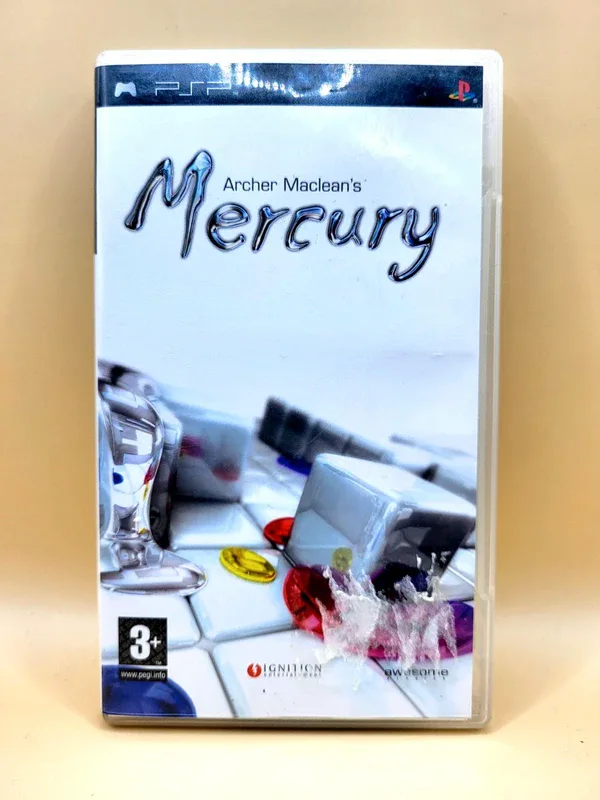
Archer Maclean's Mercury for PlayStation Portable
Archer Maclean's Mercury for PlayStation Portable is a puzzle game in which you guide liquid metal through three-dimensional mazes. You tilt the floor with the analog stick, causing the mercury to flow towards the lowest side. You therefore control the environment and need to account for the speed and shape of your blob. Narrow paths, moving platforms and open edges call for small adjustments: anything that spills over the edge is lost.
Colour plays an important part in opening passages. Change a blob's colour, split it against a sharp edge and bring coloured portions back together to create a new colour. Sometimes you must activate several switches before you can continue. Objectives emphasise different things: reach the finish within the time limit, preserve enough mercury or complete certain tasks first. The camera helps you examine the route and its obstacles.
You can play through the puzzles alone or compete against one other player over a local wireless connection. For this contest, both participants need their own PSP with wireless networking and their own copy of the game. You start the same course at the same time; a translucent blob shows your opponent's position. Additional systems and games are not included. The controls use the analog stick rather than physically tilting the handheld; no motion sensor is required.
Region and language
Our PlayStation Portable games are European editions and come with a Dutch or English box, unless stated otherwise. By default, you receive the version for the European market. We note it in the product details if the region is different or the box is in another language. In almost all cases, the game is playable at least in English, and often in the other five common European languages too.
You receive the physical UMD edition. You need a PSP with a UMD drive to play it; a PSP Go cannot play this disc.
Manual
Archer Maclean's Mercury for PlayStation Portable includes the manual unless the product title states otherwise. If the booklet is missing, the title says “No Manual”. This lets you see before ordering whether the game comes with a manual.
The manuals included with our games usually contain at least English and often around six European languages. The exact languages vary by edition, so Dutch is not always included. The booklet explains the controls and the main rules. You can use it to check how to control the game, which actions are available and how its different features work.
The history of Archer Maclean's Mercury
Awesome Studios developed Archer Maclean's Mercury for PSP, with Ignition Entertainment as publisher. The game appeared in 2005 and was part of the handheld's European launch line-up on 1 September. Maclean had previously become known for titles including Dropzone and snooker games featuring Jimmy White. With Mercury, the design shifted towards a small puzzle object whose physical properties determined how you solved a level.
The initial idea grew out of an early technical demonstration for a previous pool game. The developers expanded it with liquid metal that could separate and come together again. Colour mixing, switches and dexterity challenges turned that technology into a series of puzzles. A tilt sensor for the PSP was considered, but the final release used conventional controls. Costs and technical problems prevented the planned accessory from appearing. The analog stick let players adjust the slope of the playing field.
Mercury Meltdown followed on PSP in 2006. The team in Banbury changed the visual style and further developed the difficulty progression and camera features. Studio head Ed Bradley explained at the time that the first game had been made to a tight schedule for the PSP launch. The series later received releases on other platforms, including Mercury Hg in 2011. The Archer Maclean's Mercury UMD contains the original game, not its successor's larger collection of puzzles.
Similar games for PlayStation Portable
On PSP, Mercury Meltdown builds directly on tilting, splitting and mixing mercury. The sequel gives the puzzles a more clearly cartoon-like appearance and lets you examine the playing field more thoroughly in advance. It also allows you to finish a level after time has expired, without that attempt reaching the high-score table. Archer Maclean's Mercury uses stricter time requirements and a shinier metallic presentation. The shared foundation makes the differences in camera work and margin for error immediately noticeable.
LocoRoco on PSP also lets you tilt the world to help a deformable character move forward. Cheerfully singing creatures roll and jump through two-dimensional landscapes, controlled mainly with the shoulder buttons. Mercury uses the analog stick for a three-dimensional playing field and takes lost mercury into account when deciding whether an objective is achieved. The shape of your group matters in both, but colour mixing and mechanical switches are especially central to Mercury's puzzles.
On PSP, Lumines connects recognising colours with improving your scores. You rotate falling blocks and form squares of the same colour, which a rhythmically moving line then clears. Mercury also demands attention to colour, but uses it to guide liquid through gates and past switches. Lumines builds pressure through a filling playing field and the music's tempo; Mercury presents separate routes where precision and preserving material determine the outcome.
Crush on PSP also makes spatial awareness important when finding a passage. The game temporarily turns three-dimensional structures into a flat image, suddenly placing unreachable platforms next to each other. Mercury changes the slope of a space rather than its number of dimensions. In Crush you move a human character and look for a clever viewing angle; in Mercury you control a liquid that can stretch, split and partly disappear over an edge during the same movement.
echoshift on PSP also gives you self-contained puzzle spaces with switches, moving parts and a time limit. You replay earlier actions as a recorded echo, allowing several versions of yourself to open a route together. Mercury lets you move several blobs simultaneously by tilting one playing field. Both require planning and timing, but echoshift builds solutions out of successive time loops, whereas Mercury centres on the physical distribution of liquid in the present moment.