This product is like new. At NexWave Games, like new means:
Additionally, all discs at NexWave Games are carefully inspected and assessed for quality. When discs arrive, we do not accept any that are so badly damaged that they are unlikely to work. We only accept discs with light scratches at most. Discs with scratches are then treated in our professional disc repair machine. By warming the disc and polishing it with soft brushes, these machines can remove a very thin layer from the disc. This removes the layer containing surface scratches and improves the disc’s readability. This ensures the disc works properly, even on consoles with ageing lasers that have difficulty reading games! Great news for the player.
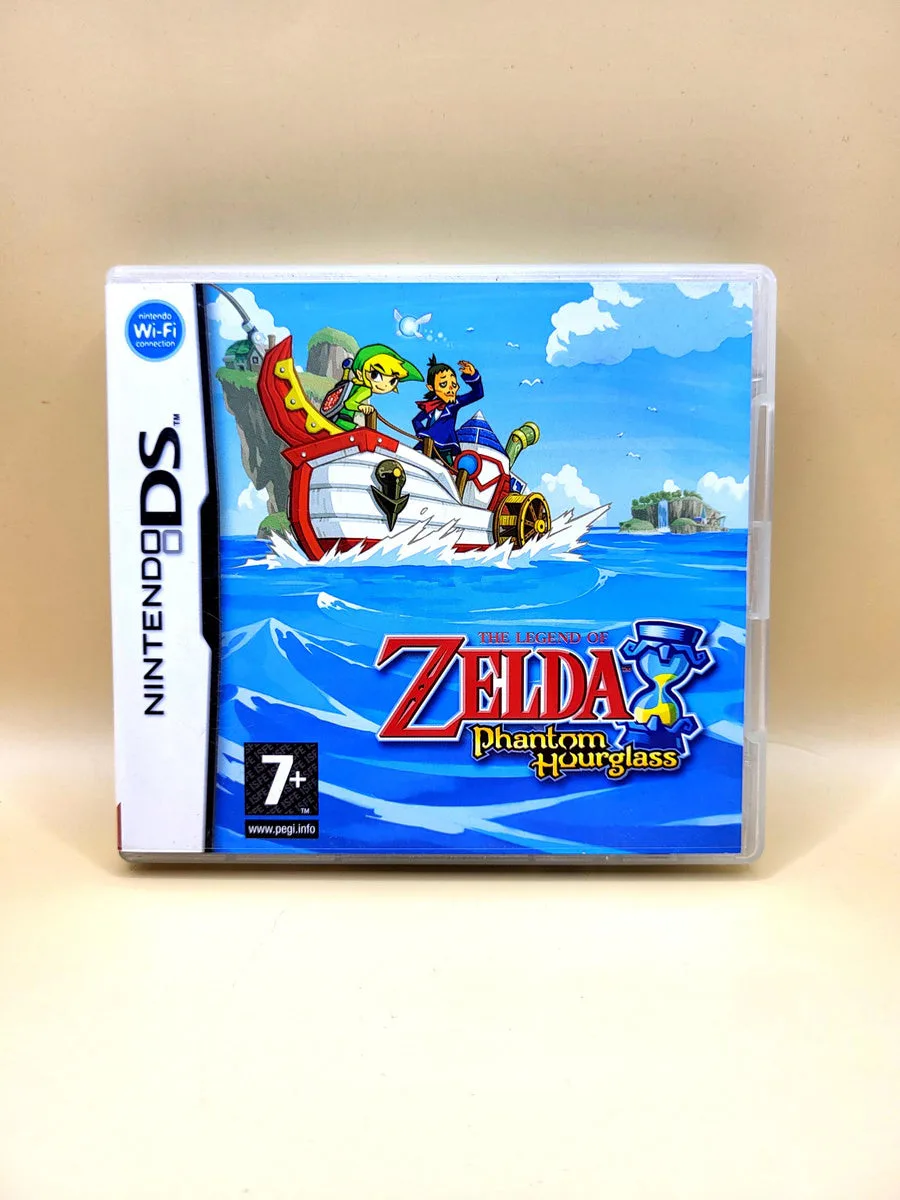
The Legend of Zelda Phantom Hourglass for Nintendo DS
In The Legend of Zelda Phantom Hourglass for the Nintendo DS, you follow Link on a quest to find Tetra, who has disappeared on a ghost ship. Together with the fairy Ciela and Captain Linebeck you sail between islands where you explore villages, caves and dungeons. You watch the adventure from above and use the stylus to make Link walk, attack enemies and operate objects.
The touchscreen gives familiar Zelda objects other possibilities. For example, you draw the route of your boomerang yourself and write directions on your map. You can save a symbol on a wall or a prominent spot on an island for later. During the boat trips you plot a course and use the cannon against dangers along the way. On land, battles and puzzles alternate.
The Temple of the Ocean King is a recurring challenge. You visit this temple several times and use the Phantom Hourglass to stay temporarily safe. New objects and knowledge of the rooms will help you progress on your next journey. You play the main adventure alone. Your progress depends mainly on looking carefully, remembering routes and thinking about how a found tool can open up a previously inaccessible place.
Region and language
Our Nintendo DS games are European editions, unless stated otherwise. This product contains a loose cartridge for the European market. A box is only included if explicitly stated in the product details. We note any different region in the product details. In almost all cases, the game is playable at least in English, and often in the other five common European languages too.
Manual
With The Legend of Zelda Phantom Hourglass for Nintendo DS, you receive a loose cartridge. A box and manual are not included unless we explicitly state otherwise in the product details. This is the standard way we supply this copy.
The history of The Legend of Zelda Phantom Hourglass
The Legend of Zelda Phantom Hourglass was released in 2007 as the first Zelda adventure for the Nintendo DS. The European edition came out on October 19. Nintendo connected the story to The Wind Waker: Link and Tetra sailed further, while the recognizable cartoon style on the handheld was given a new perspective. The journey across the sea thus connects the GameCube game with this separate quest.
Development started in 2004, after Four Swords Adventures. Daiki Iwamoto and his team explored how Zelda could work with two screens and a stylus. In an early design, the action took place on the top screen and you controlled Link via a card below. The makers found the distance between touch and action too great and moved the game image to the touchscreen.
Nintendo showed off Phantom Hourglass at the 2006 Game Developers Conference. The touch controls became a central part of the release: drawing, pointing and taking notes took on a practical function within the adventure. The continued investigation of one large temple also gave the game its own structure. Spirit Tracks continued to build on the controls in 2009, but replaced the boat trips with train rides. Two different Zelda adventures were built around the same capabilities of the Nintendo DS.
Similar games for Nintendo DS
The Legend of Zelda: Spirit Tracks also uses the stylus for walking, fighting and objects. The boat makes way for a train and Zelda helps you with puzzles by controlling a Phantom. Phantom Hourglass lets you return more often to a temple where your knowledge from previous visits can save time.
Okamiden also gives drawing a direct role during battles and puzzles. You use the Celestial Brush to summon powers and work with various companions. Phantom Hourglass centers the controls around Link, his equipment, and your own notes. Both require you to investigate an environment and devise an appropriate action on the touchscreen.
Final Fantasy Crystal Chronicles: Ring of Fates combines dungeons, switches and instant battles. Equipment and the properties of different characters play a major role in this. Phantom Hourglass builds more puzzles around Link and a recognizable object, such as the boomerang. You mainly learn what you can achieve with this in a new room.
In Avalon Code you explore a fantasy world with the help of a magical book. You collect data and change properties of objects and enemies. This ties in with the pleasure of understanding directions and using a tool wisely. Phantom Hourglass keeps the solutions closer to space, routes and drawing a targeted movement.
Solatorobo Red the Hunter connects visits to different islands with a larger story and assignments. Red uses his robot to lift objects and opponents. Phantom Hourglass uses sea travel as a connection and lets you understand new places mainly through puzzles. In both games you will get to know a series of distinct communities and environments.