This product is like new. At NexWave Games, like new means:
Additionally, all discs at NexWave Games are carefully inspected and assessed for quality. When discs arrive, we do not accept any that are so badly damaged that they are unlikely to work. We only accept discs with light scratches at most. Discs with scratches are then treated in our professional disc repair machine. By warming the disc and polishing it with soft brushes, these machines can remove a very thin layer from the disc. This removes the layer containing surface scratches and improves the disc’s readability. This ensures the disc works properly, even on consoles with ageing lasers that have difficulty reading games! Great news for the player.
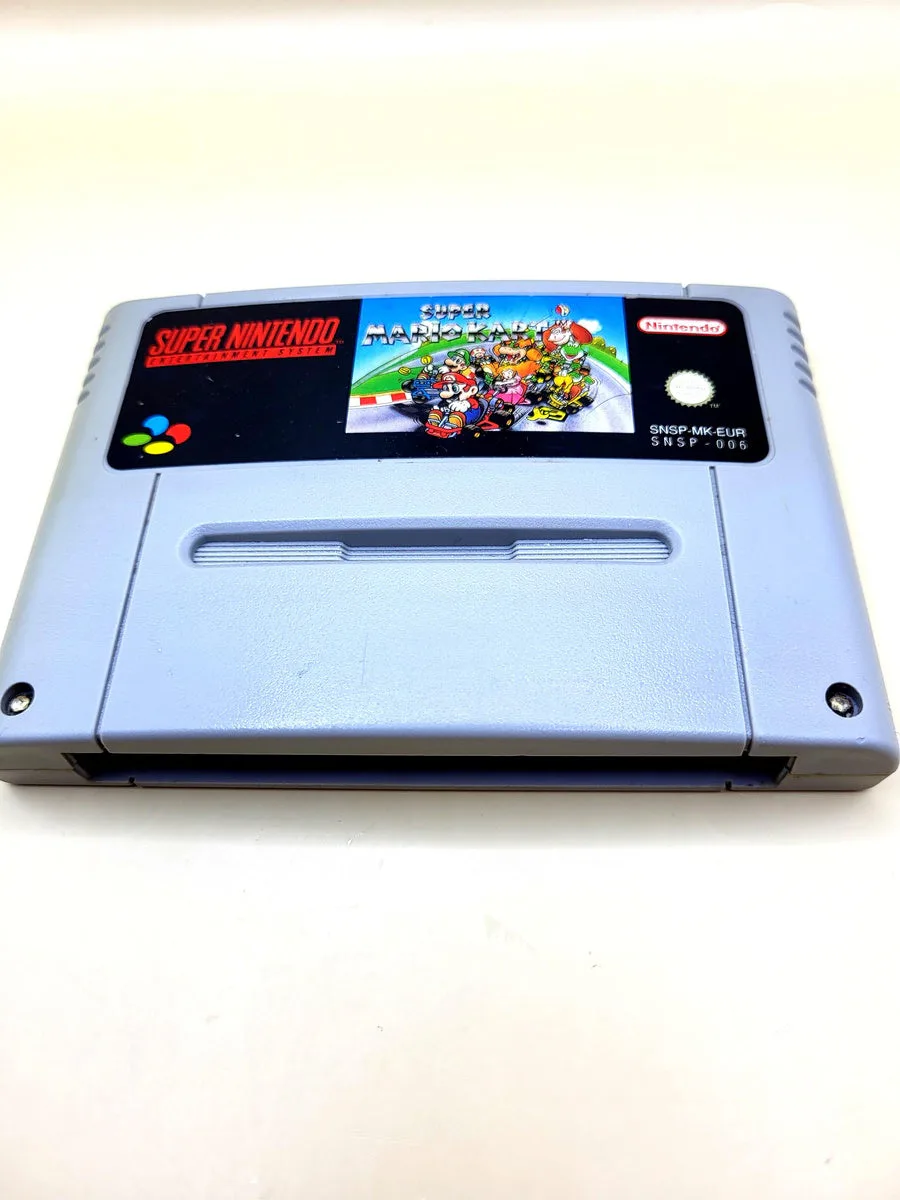
Super Mario Kart for Super Nintendo SNES
Super Mario Kart for Super Nintendo SNES puts eight characters from Mario's world into small racing karts. You choose Mario, Yoshi, Bowser or Donkey Kong Jr., for example, and steer around compact circuits with sharp corners, loose surfaces and obstacles. The drivers differ in acceleration, top speed and cornering. A well-timed hop puts your kart into a power slide. Coins help you build speed, while collisions and item hits cost you coins.
During Grand Prix, you collect items from marked panels. Shells hit other karts, banana peels remain on the track and a mushroom gives a short burst of speed. Each cup consists of five races of five laps. You try to finish in the top four each time to advance. Time Trial removes the items and coins, letting you work solely on your racing line, cornering and lap time.
You can race alone or play with two people simultaneously on a split screen. You each use an ordinary SNES controller; no Multitap is needed. Alongside Grand Prix and Match Race, there is Battle, where you try to hit each other's balloons in arenas. The cartridge saves the cups you have earned and your best Time Trial times.
Region and language
Our Super Nintendo SNES games are PAL editions, unless stated otherwise. This product contains a loose cartridge for the European market. A box is only included if explicitly stated in the product details. We note any different region in the product details. In almost all cases, the game is playable at least in English, and often in the other five common European languages too.
Manual
With Super Mario Kart for Super Nintendo SNES, you receive a loose cartridge. A box and manual are not included unless we explicitly state otherwise in the product details. This is the standard way we supply this copy.
The history of Super Mario Kart
Nintendo developed Super Mario Kart for SNES and first released it in Japan in 1992. Europe followed in 1993. Hideki Konno and Tadashi Sugiyama shared the director's role, with Shigeru Miyamoto as producer. Konno concentrated mainly on the game system and technical decisions, while Sugiyama handled the visual design. In Nintendo's retrospective, they describe a small team of eight people who worked on the game for roughly a year.
The project began with experiments for a racing game that could display two players simultaneously. F-Zero had already shown what the console could do with rotating track graphics, but its long straights did not suit the intended split screen. The team therefore chose shorter, winding circuits and karts. The first drivers were similar figures in overalls. Mario and his familiar companions joined because their colours and shapes made them immediately recognisable from behind as well.
Items then found their place within that Mario world: banana peels, shells and lightning influenced the race. Battle added a separate duel where hitting balloons mattered more than reaching a finish line. This first entry established several rules that returned in later Mario Kart games. The SNES release remains limited to two human players and the original tracks; four players, motorbikes and online races from later entries are not present here.
Similar games for Super Nintendo SNES
F-Zero likewise gives you a view from behind your vehicle over a rotating track on SNES. It focuses on high speeds, energy management and avoiding the track edges. Super Mario Kart uses smaller circuits, items and drivers with different handling characteristics. The important practical difference is the player count: the original F-Zero is a solo game, while Super Mario Kart lets two players race simultaneously and also offers a separate balloon battle.
Street Racer also combines distinctive characters with races in which you hinder opponents on SNES. Alongside driving, you can attack at close range, and there are other types of competition, including football. Super Mario Kart uses collected items and has Battle arenas with balloons. Street Racer supports more than two human players when you have the necessary Multitap and controllers; Super Mario Kart stays with two players using the ordinary controller ports.
Rock n' Roll Racing also offers armed races on SNES, but views the track from an angled overhead perspective. You earn money to improve vehicles and parts, and use weapons to take out rivals. Super Mario Kart gives each driver fixed handling characteristics and distributes temporary items along the way. Both require control through busy corners, but Rock n' Roll Racing adds vehicle management where Mario uses a short cup competition.
Top Gear likewise lets two players drive simultaneously on a split screen on SNES. It uses sports cars, longer road courses, fuel and pit stops. Super Mario Kart concentrates its races on small circuits where shells, bananas and coins affect the outcome. Knowing the corners helps in both games, but Top Gear also requires attention to the distance before your next refuelling stop. Mario additionally offers arenas without ordinary laps or a finish line.
Like Super Mario Kart, Unirally on SNES centres on short races, speed and local opponents. However, you control a unicycle on side-view tracks. Aerial stunts provide extra speed, making a jump an opportunity to gain time. Mario uses cornering, coins and items to build a lead. Unirally replaces the circuits viewed from behind with loops, slopes and platform-like routes that require a different style of control.