This product is like new. At NexWave Games, like new means:
Additionally, all discs at NexWave Games are carefully inspected and assessed for quality. When discs arrive, we do not accept any that are so badly damaged that they are unlikely to work. We only accept discs with light scratches at most. Discs with scratches are then treated in our professional disc repair machine. By warming the disc and polishing it with soft brushes, these machines can remove a very thin layer from the disc. This removes the layer containing surface scratches and improves the disc’s readability. This ensures the disc works properly, even on consoles with ageing lasers that have difficulty reading games! Great news for the player.
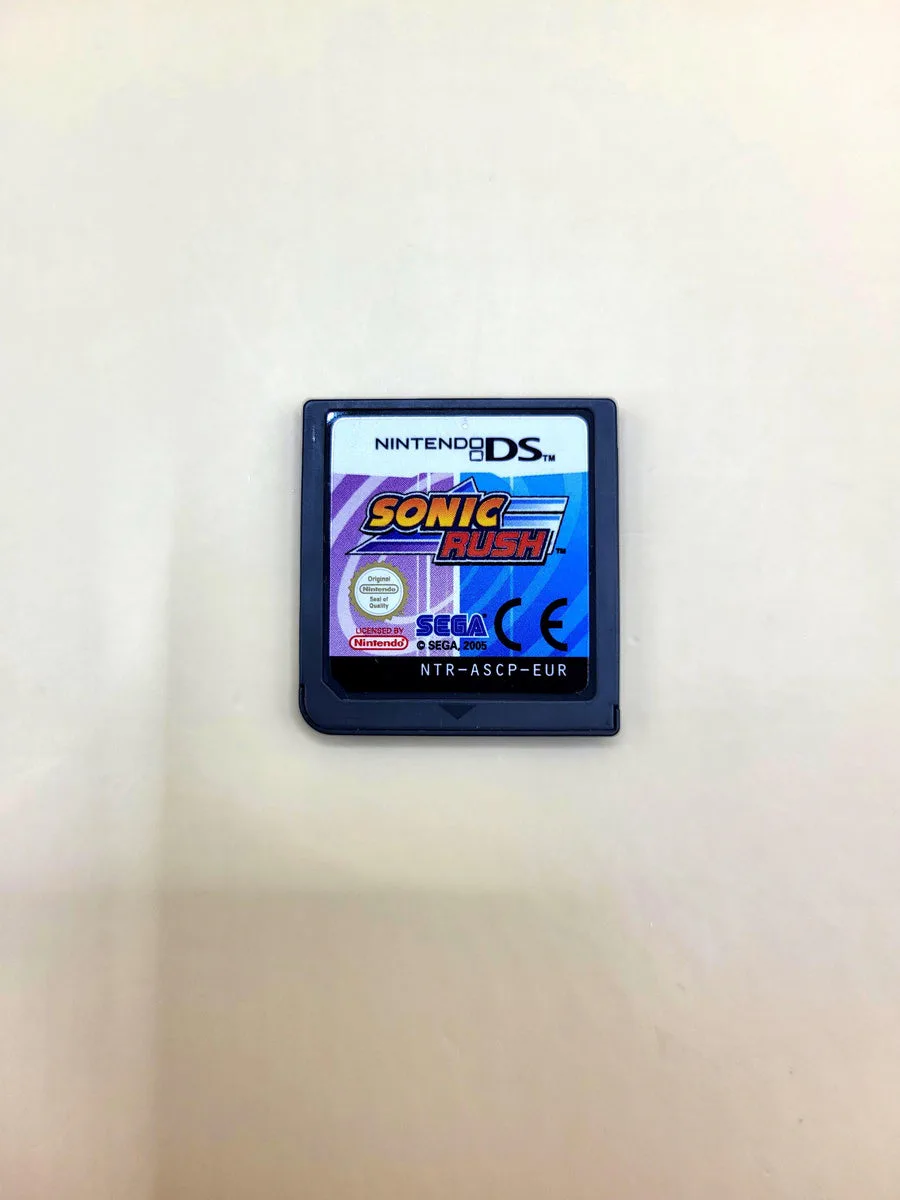
Sonic Rush for Nintendo DS
Sonic Rush for Nintendo DS is a fast side-scrolling platform game in which Sonic and Blaze the Cat each follow their own adventure. The two screens form one tall playfield: you speed through loops, dive down a slope and jump from one screen to the other. Sonic hunts Chaos Emeralds, while Blaze tries to recover the Sol Emeralds from her own world. Dr. Eggman and Eggman Nega cause their paths to cross.
Jumps, attacks and tricks fill the Tension Gauge. You spend that energy on a boost that keeps your speed up and hits enemies in your path. A fast run takes practice: spot a pit, choose a higher route and land ready to keep moving. In the special stages you steer Sonic along a three-dimensional course with the stylus. The regular platform action uses the buttons.
After you defeat a zone boss, the game automatically saves your progress on the cartridge. Alongside the solo adventure, you can race one other player locally. DS Download Play requires two DS systems and one game cartridge; with two cartridges you can start the same races through Multi-Card Play. The second system and any additional cartridge are not included.
Region and language
Our Nintendo DS games are European editions, unless stated otherwise. This product contains a loose cartridge for the European market. A box is only included if explicitly stated in the product details. We note any different region in the product details. In almost all cases, the game is playable at least in English, and often in the other five common European languages too.
Manual
With Sonic Rush for Nintendo DS, you receive a loose cartridge. A box and manual are not included unless we explicitly state otherwise in the product details. This is the standard way we supply this copy.
The history of Sonic Rush
Sega released Sonic Rush in 2005 as the first Sonic adventure for Nintendo DS. Sonic Team worked with Dimps, which had also worked on the Sonic Advance games. Development was led by Akinori Nishiyama. For Nintendo's new system, the team wanted to retain the side-scrolling action while doing something with the two screens. This led to levels in which the height of both displays became part of the route.
In an interview, Nishiyama explained that moving between the screens required considerable adjustment. Players needed to predict where Sonic would appear, otherwise they lost sight of him. The established side-scrolling rules were combined with three-dimensional characters and striking boss battles. The Tension Gauge encouraged a continuous sequence of tricks and boosts. The resulting handheld game makes recognising a route increasingly important as you run faster.
Blaze the Cat made her debut here. Her reserved personality and origins in another world gave the story a second perspective alongside Sonic. Rush also gained a distinct musical sound: Hideki Naganuma, known for Jet Set Radio, wrote most of its music. The sequel Sonic Rush Adventure appeared on the same handheld in 2007 and expanded the formula with islands and watercraft.
Similar games for Nintendo DS
Sonic Rush Adventure for Nintendo DS builds on the fast side-scrolling action and playfield spread over two screens. You also sail between islands using the stylus and collect materials for new watercraft. The first Sonic Rush keeps the journey more closely focused on Sonic and Blaze's successive platform areas. The choice is therefore between a more direct series of speed-based stages and a sequel that connects those stages through sea journeys.
Sonic Colours on Nintendo DS links Sonic's speed to the powers of small alien Wisps. These let you drill through the ground, for example, or turn into a laser to reach another passage. In Sonic Rush, you mainly open routes through jumping, tricks and well-timed boosts. Both reward replaying a level, but Colours adds temporary transformations to the search for a faster line.
New Super Mario Bros. for Nintendo DS also centres on side-scrolling running, jumping and finding secret routes. Mario uses items including the Mega Mushroom and Mini Mushroom to change his size and abilities. In Sonic Rush, stored boost energy and maintaining momentum determine your approach. Mario more often lets you deliberately pause at a block or entrance; Sonic asks you to learn to read that same environment ever faster.
Kirby: Mouse Attack combines platform action on Nintendo DS with copying and combining enemy abilities. The stylus helps you manage and mix items on the lower screen. In Sonic Rush, the platform route instead extends across both screens, and the stylus mainly comes into play in the special stages. Kirby invites you to try an ability, while Sonic rewards a smoothly executed route.
Like Sonic Rush, Yoshi's Island DS uses the height of two screens for its platform areas. Yoshi carries different babies, which change his abilities; switching passengers can put a passage within reach. Sonic and Blaze each have their own story and movements, with speed as the common thread. Yoshi's routes more often involve exploring and choosing the right baby, while Rush focuses on timing and maintaining momentum.