This product is like new. At NexWave Games, like new means:
Additionally, all discs at NexWave Games are carefully inspected and assessed for quality. When discs arrive, we do not accept any that are so badly damaged that they are unlikely to work. We only accept discs with light scratches at most. Discs with scratches are then treated in our professional disc repair machine. By warming the disc and polishing it with soft brushes, these machines can remove a very thin layer from the disc. This removes the layer containing surface scratches and improves the disc’s readability. This ensures the disc works properly, even on consoles with ageing lasers that have difficulty reading games! Great news for the player.
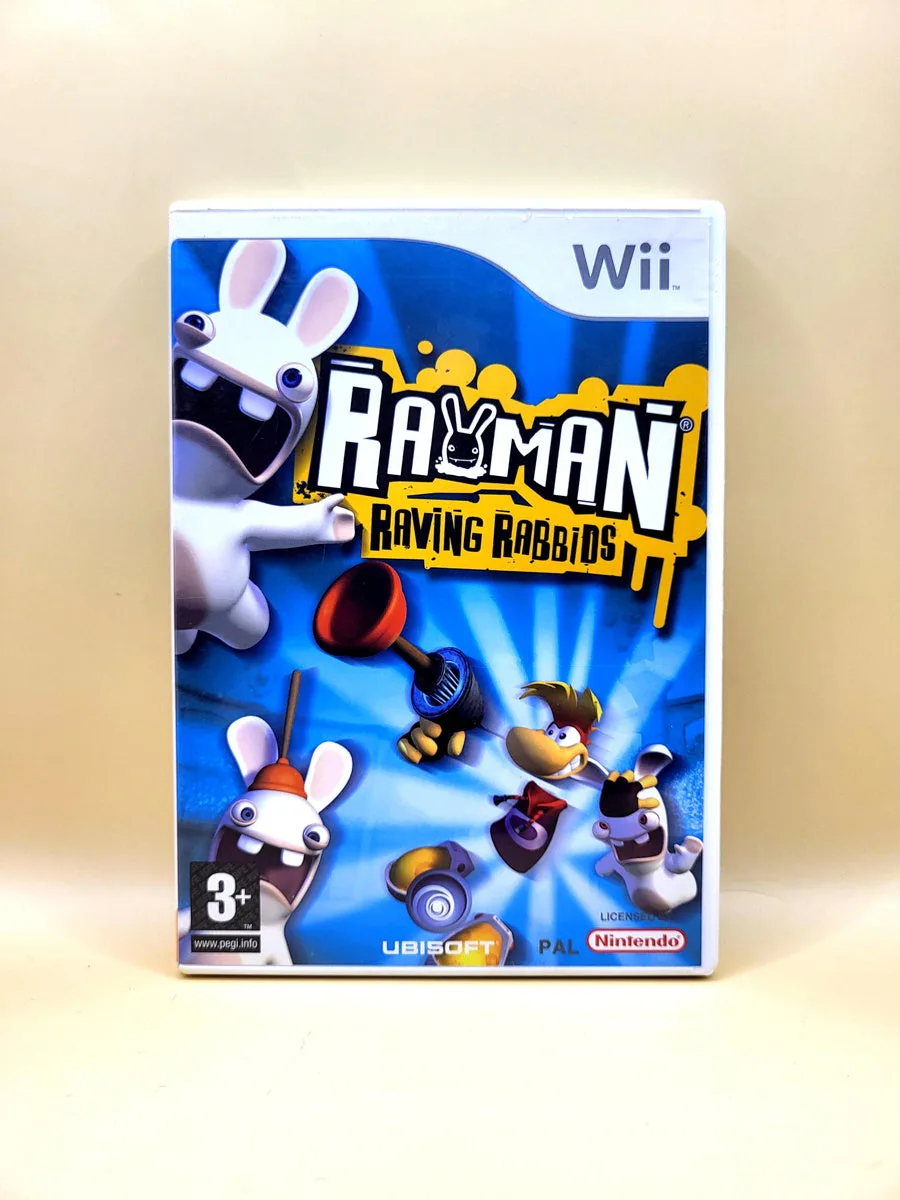
Rayman Raving Rabbids for Nintendo Wii
Rayman Raving Rabbids for Nintendo Wii is a party game with short tasks involving rhythm, reactions and aiming. A group of crazed rabbits kidnaps Rayman and forces him to perform before a noisy audience. You try to win the trials to break his captivity. Each challenge first explains its own rules and controls. One may require precise reactions, another a steady rhythm or hitting targets with a toilet plunger.
A story day begins with four qualifying trials. Winning at least three opens the door to the final fifth trial. Rayman then returns to his cell, where you can listen to unlocked music and change clothing. Completed days can be replayed, and unlocked trials appear separately under Score. You therefore need not follow the whole story whenever you mainly want to improve a time or previous result.
On Wii, you use the Wii Remote and Nunchuk for aiming, rhythm and gestures that change between trials. You play the story alone. In Score, up to four participants can try unlocked challenges, simultaneously or in turns depending on the trial. For simultaneous play, each player needs their own remote and, where the trial uses it, a Nunchuk. The instructions explain the objective beforehand; reacting quickly only helps once you understand the required movement.
Region and language
Our Nintendo Wii games are PAL editions and come with a Dutch or English box, unless stated otherwise. By default, you receive the version for the European market. We note it in the product details if the region is different or the box is in another language. In almost all cases, the game is playable at least in English, and often in the other five common European languages too.
Manual
Rayman Raving Rabbids for Nintendo Wii includes the manual unless the product title states otherwise. If the booklet is missing, the title says “No Manual”. This lets you see before ordering whether the game comes with a manual.
The manuals included with our games usually contain at least English and often around six European languages. The exact languages vary by edition, so Dutch is not always included. The booklet explains the controls and the main rules. You can use it to check how to control the game, which actions are available and how its different features work.
The history of Rayman Raving Rabbids
Ubisoft Montpellier developed Rayman Raving Rabbids, and Ubisoft released the Wii version in 2006. The game introduced the Rabbids as Rayman’s new opponents. Their unpredictable behaviour became the basis for short trials and visual jokes. Rayman remained the controlled character, but progress did not follow continuous platform areas as in Revolution or Rayman 3. The arena, days and return to a cell connected the separate tasks.
The first announcement in spring 2006 still described a broader adventure with large worlds and other ideas that did not appear in that form in the finished game. The final Wii manual shows the changed structure: qualifying trials, a final and a cell Rayman returns to between days. The Wii Remote and Nunchuk became tools for varied short actions. Variety came not from a long platforming area but from a new rule and movement each time.
Raving Rabbids appeared in December 2006 at Wii’s European launch. It began a separate series centred on the rabbits, with sequels such as Rayman Raving Rabbids 2 and TV Party. Those games developed the short challenges further in other settings. The first instalment retains Rayman’s captivity as the link between trials. His cell, performances and audience therefore give a recognisable progression to what would later become largely an independent party-game series.
Similar games for Nintendo Wii
Rayman Raving Rabbids 2 builds on short gesture-based tasks and rabbit humour on Wii. Its trials use everyday settings and a wider world tour as their backdrop. The first instalment keeps Rayman captive near an arena and ties progress to individual days. If you want to work through those daily qualifiers, this game places a clearer prison story around the collection.
TV Party turns television programmes and advertisements into new rabbit trials on Wii. Certain activities also support the Wii Balance Board. The first Raving Rabbids does not have that television structure or those Balance Board activities. They overlap in rhythm, reactions and absurd tasks; the differences lie in the available control methods and how the individual challenges are connected.
WarioWare: Smooth Moves also uses unexpected gestures and brief rules on Wii. Its microgames often last only a few seconds and arrive in quick succession. Raving Rabbids gives a trial more time for a rhythm, objective or score. It explains more beforehand and lets you repeat an unlocked challenge separately rather than continually completing a chain of ultra-short reactions.
Mario Party 8 also offers varied minigames using aiming, timing and gestures on Wii. Its boards and star collection determine the course of a match, however. Raving Rabbids uses qualifying trials and a final within Rayman’s story. Individual trials focus on personal records or competing scores, without a board route changing positions in between.
Wii Play uses a smaller set of activities to practise pointing and moving the remote on Wii. Its shooting range and simple billiards have much plainer presentation than Rayman’s performances. Raving Rabbids builds each task around a joke, rhythm or unusual action. Both let you improve scores, but the rabbits more often give the rules an unexpected form.