This product is like new. At NexWave Games, like new means:
Additionally, all discs at NexWave Games are carefully inspected and assessed for quality. When discs arrive, we do not accept any that are so badly damaged that they are unlikely to work. We only accept discs with light scratches at most. Discs with scratches are then treated in our professional disc repair machine. By warming the disc and polishing it with soft brushes, these machines can remove a very thin layer from the disc. This removes the layer containing surface scratches and improves the disc’s readability. This ensures the disc works properly, even on consoles with ageing lasers that have difficulty reading games! Great news for the player.
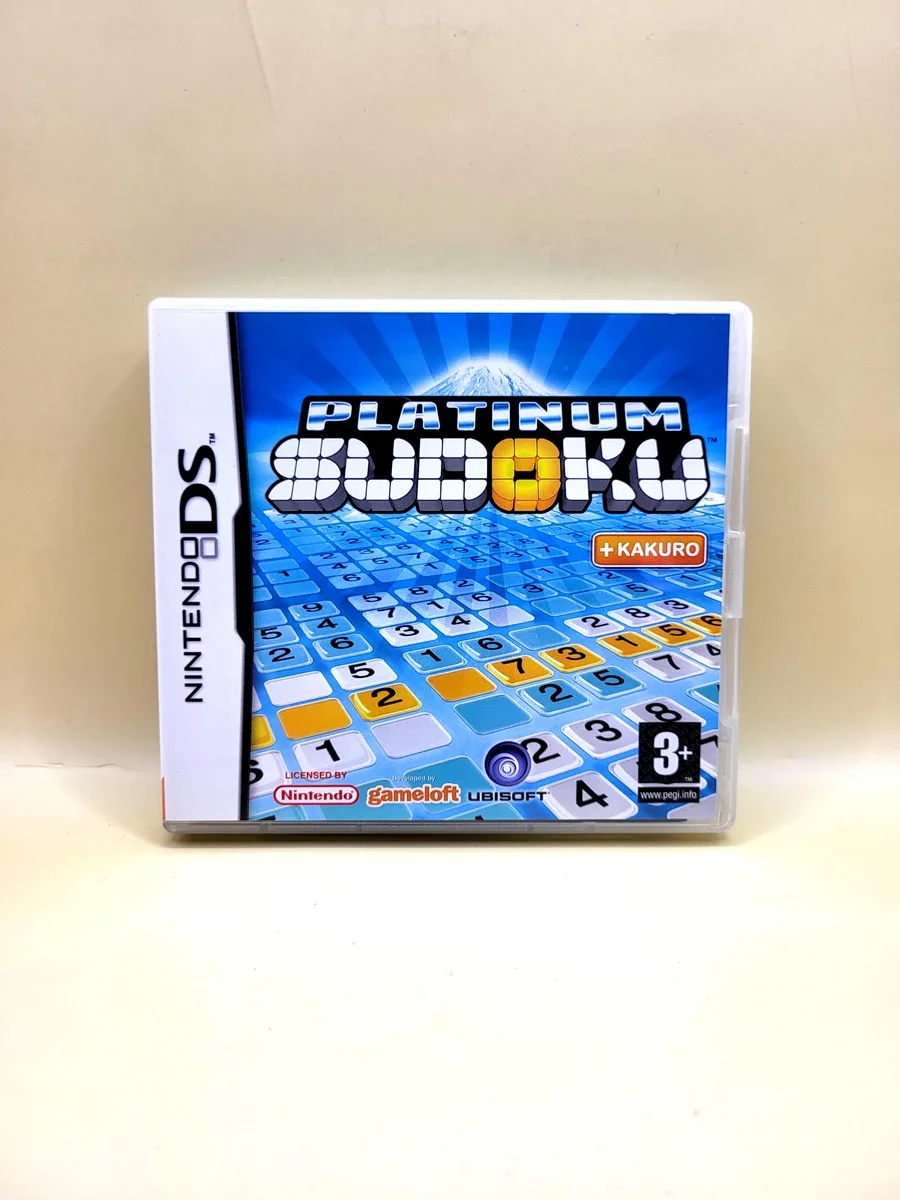
Platinum Sudoku for Nintendo DS
Platinum Sudoku for Nintendo DS revolves around number puzzles you fill in with the stylus. In a grid of nine by nine cells, you place the numbers one to nine. Each number may appear only once in every row, column and three-by-three box. You examine the filled cells, eliminate possibilities and work towards the solution. The explanations start with the basic rules before letting you tackle increasingly difficult grids.
You can write numbers or select them using the input buttons, and leave possible answers as notes inside a cell. Assistance can show candidates, enter an answer or mark errors. Alongside sudoku, the game includes kakuro, where sequences of numbers must add up to the indicated total. Completing puzzles unlocks extra content and presentation options. You can also enter a grid yourself, allowing a puzzle found elsewhere to be worked out on the handheld.
With different difficulty levels and an unlockable collection of millions of grids, you can stay with the same type of puzzle for a long time. Small number and logic games provide variety. Locally, two players can solve a sudoku together or race against each other. Each needs their own DS system AND their own copy of Platinum Sudoku; sharing one cartridge through Download Play is not possible here.
Region and language
Our Nintendo DS games are European editions, unless stated otherwise. This product contains a loose cartridge for the European market. A box is only included if explicitly stated in the product details. We note any different region in the product details. In almost all cases, the game is playable at least in English, and often in the other five common European languages too.
Manual
With Platinum Sudoku for Nintendo DS, you receive a loose cartridge. A box and manual are not included unless we explicitly state otherwise in the product details. This is the standard way we supply this copy.
The history of Platinum Sudoku
Platinum Sudoku appeared for Nintendo DS in 2007, developed by Gameloft and published by Ubisoft. Gameloft had already used the name for an earlier mobile puzzle game. The DS version received Touch Screen-based controls and a broad collection of puzzle types. It arrived at a time when number grids from newspapers and puzzle books were also finding a regular place on handheld games systems. Nintendo's own Brain Training had already combined sudoku with other short exercises.
Ubisoft presented this release with twenty million possible sudoku grids and five increasing difficulty levels. Kakuro also received its own place, adding the need to sum sequences of numbers as well as eliminate possibilities. The large collection was not completely open from the start: progressing through the fixed puzzles unlocked extra grids and activities. Backgrounds, fonts and music also formed part of the reward system, alongside the next puzzle challenge.
The DS release combined the familiar paper grid with digital tools such as notes, checking functions and a solver for entered puzzles. Two people could cooperate or compete through local wireless play. Platinum Sudoku also appeared for iPhone in 2008. This is the Nintendo DS version from 2007, with its own screen layout, controls and local connection between two Game Cards.
Similar games for Nintendo DS
Dr Kawashima's Brain Training for Nintendo DS also includes sudoku, but combines it with short sums, reading tasks and memory work. Platinum Sudoku focuses more closely on solving grids and offers more types of assistance and settings for that purpose. You particularly notice the difference when spending longer on one number puzzle: Brain Training has a broader daily exercise routine, while Platinum Sudoku is built around the number puzzle itself.
More Brain Training on Nintendo DS again uses a guided collection of daily tasks, with new content compared with the first Brain Training. Platinum Sudoku does not put a daily test or brain age at the centre. You select a grid and work with the available logical information. Both reward repeated practice, but here progress mainly involves unlocking puzzles and tackling harder sudokus rather than alternating between different exercise types.
Picross DS for Nintendo DS also asks you to determine cells using numbers. There, clues sit outside the playing field and describe runs of filled squares that form a picture. Platinum Sudoku instead has you place numbers inside the cells without repetition in rows, columns and boxes. Both involve careful elimination, but reading the clues and the eventual result call for a different approach.
Polarium for Nintendo DS likewise uses a simple grid and stylus controls, but revolves around flipping black and white tiles. A carefully chosen line aims to make rows the same colour. Platinum Sudoku does not ask for a line through several tiles: you determine a number for each cell based on other numbers. Both begin with a few clear rules, then put increasing importance on thinking ahead and recognising patterns.
Big Brain Academy on Nintendo DS switches quickly between minigames involving arithmetic, memory, analysis and recognition. Your result depends on your pace and the number of correct answers. Platinum Sudoku also has small interludes, but its main activity revolves around a complete number grid. This allows you to stay with one line of reasoning for longer. Both involve active thinking; one seeks quick responses, the other a logically constructed solution.