This product is like new. At NexWave Games, like new means:
Additionally, all discs at NexWave Games are carefully inspected and assessed for quality. When discs arrive, we do not accept any that are so badly damaged that they are unlikely to work. We only accept discs with light scratches at most. Discs with scratches are then treated in our professional disc repair machine. By warming the disc and polishing it with soft brushes, these machines can remove a very thin layer from the disc. This removes the layer containing surface scratches and improves the disc’s readability. This ensures the disc works properly, even on consoles with ageing lasers that have difficulty reading games! Great news for the player.
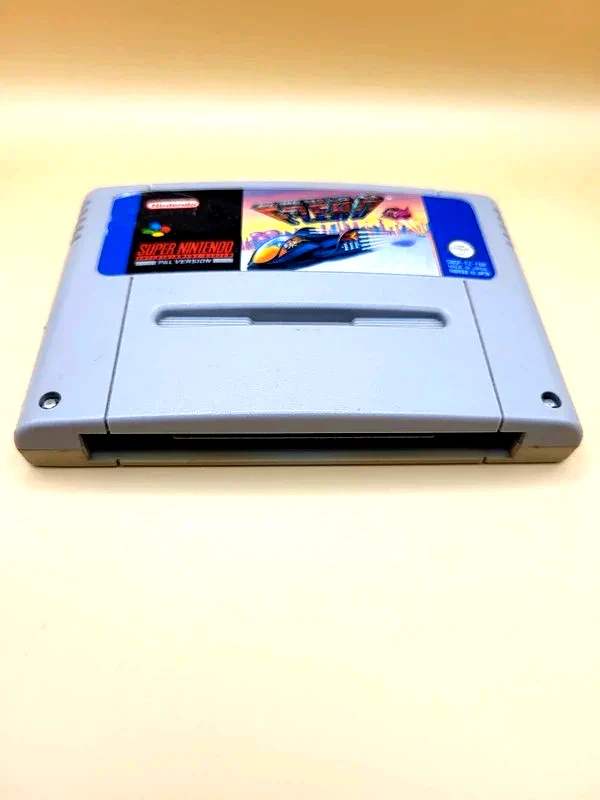
F-Zero for Super Nintendo SNES
F-Zero for Super Nintendo SNES is a futuristic racing game in which you speed a hovering machine around narrow circuits. You choose between Blue Falcon, Golden Fox, Wild Goose and Fire Stingray. Their speed, acceleration and handling differ, so the same corner feels different with each machine. The track rotates beneath your vehicle while cities and alien landscapes appear on the horizon. You keep looking further ahead to spot a sharp bend or jump plate in time.
The fifteen circuits are divided between the Knight, Queen and King Leagues. During a Grand Prix, you must finish each lap in a high enough position to continue. Collisions with other vehicles and the energy barriers damage your machine. Driving over repair strips replenishes the energy meter. After completing a lap, you receive a Super Jet for a short burst of speed. You can hold up to three, letting you decide which straight to use them on.
F-Zero is strictly a single-player game; the other machines are controlled by the computer. In Practice, you train on seven circuits, with or without one computer rival. You try a tighter line, change the timing of your boost and compare lap times. The cartridge stores race times. The shoulder buttons shift your machine's weight left or right, helping you turn more sharply without losing speed unnecessarily.
Region and language
Our Super Nintendo SNES games are PAL editions, unless stated otherwise. This product contains a loose cartridge for the European market. A box is only included if explicitly stated in the product details. We note any different region in the product details. In almost all cases, the game is playable at least in English, and often in the other five common European languages too.
Manual
With F-Zero for Super Nintendo SNES, you receive a loose cartridge. A box and manual are not included unless we explicitly state otherwise in the product details. This is the standard way we supply this copy.
The history of F-Zero
Nintendo released F-Zero in Japan on 21 November 1990, alongside the Super Famicom. The European Super Nintendo followed in 1992. The game was made by Nintendo's own developers, with Kazunobu Shimizu directing, Yasunari Nishida as lead programmer and Takaya Imamura as designer. In a later Nintendo interview, they explained that a small team worked on the game. Meanwhile, the programmers were exploring what the new console could do with rotating and scaling backgrounds.
Nishida built a racing experiment using the Mode 7 graphics feature. Most of the screen rotated with the track, leaving room at the top for the distant background. That experiment became F-Zero's technical foundation. The first vehicles still had wheels. According to the team, choosing hovering machines made it easier to draw all the vehicle angles. The elevated tracks also fitted the technical limitations: the city could remain far below the circuit.
During development, invisible walls around the track were removed. This allowed jumps beyond the normal route and short cuts, with an explosion if you landed badly. Imamura also developed Captain Falcon and the other drivers in an American comic-book style. The original manual used a comic to introduce their world. On SNES, the racing itself remained a solo experience; the larger starting grids and multiplayer races of later F-Zero games are not part of this first release.
Similar games for Super Nintendo SNES
Super Mario Kart for SNES also rotates the track beneath your vehicle, but builds its races around karts, items and familiar Mario characters. Two players can race directly against each other. F-Zero focuses on one driver, higher speeds and conserving energy. Both involve learning corners and shortcuts, but F-Zero gives you no shell or banana to rescue a poor lap.
Stunt Race FX on SNES uses three-dimensional vehicles and tracks, with slopes, tunnels and recognisable cars with eyes. A damaged vehicle also needs attention and repairs there. F-Zero presents its circuit as a rotating plane and responds much faster to small steering inputs. Stunt Race FX places more emphasis on a course's shape and elevation; F-Zero on clean lines, heavy traffic and a boost you save carefully.
Top Gear for SNES puts you in ordinary sports cars on roads across different countries. Fuel, pit stops and traffic help shape the race, while a second player can join directly. F-Zero replaces the road car with a hovering machine and an energy meter, and is strictly single-player. Avoiding collisions helps in both, but in F-Zero a badly judged jump can immediately send you off the track.
Rock n' Roll Racing on SNES shows races from an angled overhead view and gives you weapons to damage the other cars. Between races, you invest money in vehicles and upgrades. F-Zero keeps its four machines' characteristics fixed and does not let you buy missiles. Contact can cost valuable speed in both; in F-Zero, victory mainly comes from steering and track knowledge, while Rock n' Roll Racing also factors in combat and purchases.
Unirally for SNES also demands quick reactions at high speed, but shows unicycles side-on on tracks full of loops and slopes. You perform jumps and tricks to gain speed. F-Zero instead uses a rear view, energy management and temporary Super Jets. Both reward memorising a course; in Unirally, you think about the next trick and landing, while F-Zero makes you watch the circuit's width and corners.