This product is like new. At NexWave Games, like new means:
Additionally, all discs at NexWave Games are carefully inspected and assessed for quality. When discs arrive, we do not accept any that are so badly damaged that they are unlikely to work. We only accept discs with light scratches at most. Discs with scratches are then treated in our professional disc repair machine. By warming the disc and polishing it with soft brushes, these machines can remove a very thin layer from the disc. This removes the layer containing surface scratches and improves the disc’s readability. This ensures the disc works properly, even on consoles with ageing lasers that have difficulty reading games! Great news for the player.
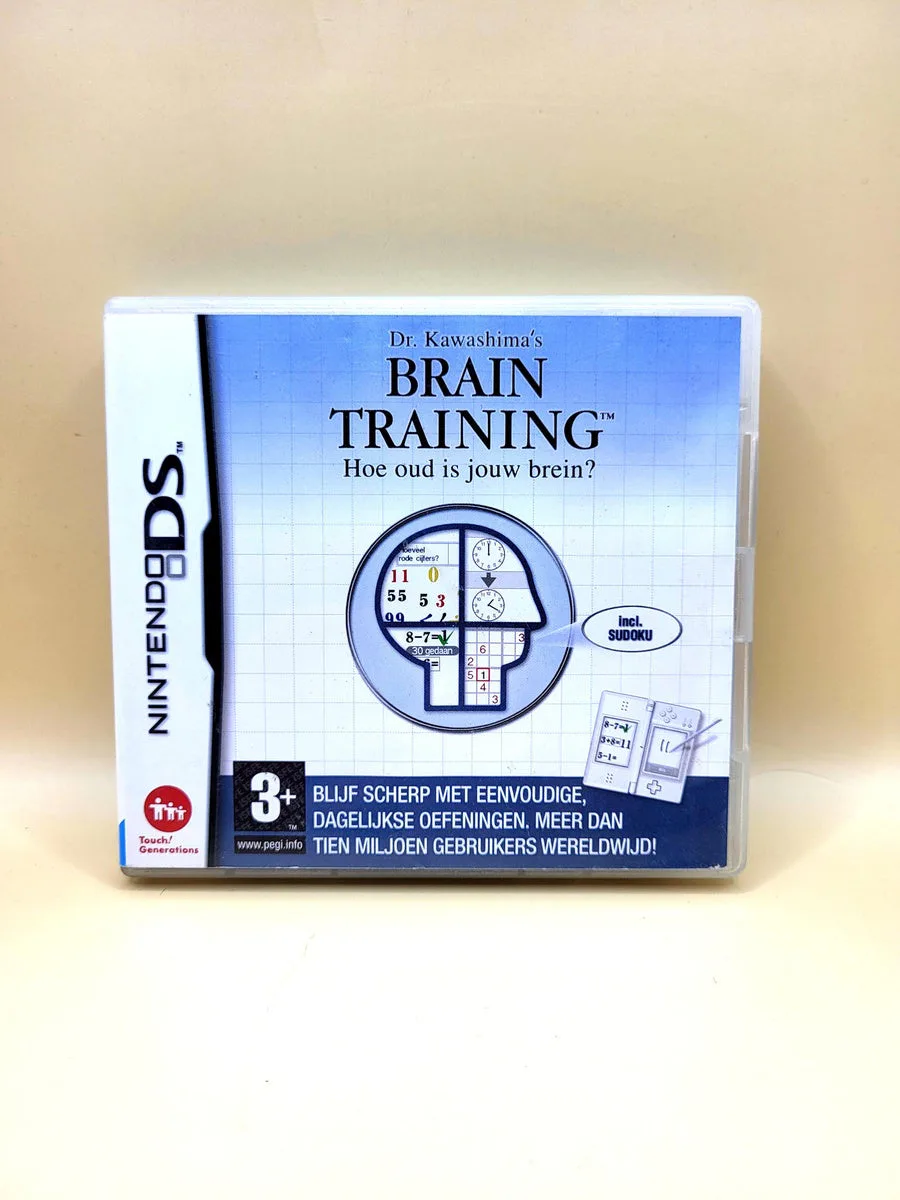
Dr Kawashima's Brain Training: How Old Is Your Brain? for Nintendo DS
Dr Kawashima's Brain Training: How Old Is Your Brain? for Nintendo DS brings together short arithmetic, reading and memory exercises. You hold the handheld like a book and write answers with the stylus. Some tasks use the microphone. Dr Kawashima's digital face explains what to do and guides you through the daily exercises. A quick session introduces the tasks; a personal profile lets you follow your results over a longer period.
During practice, you might solve a succession of simple sums, remember numbers or read a passage aloud. The tasks call for different ways of observing and responding. You collect stamps on the calendar for days when you have practised, and graphs display previous results. The cartridge has room for four personal profiles. The game also includes sudoku puzzles, in which you distribute the numbers one to nine across rows, columns and boxes without repetition.
In the local arithmetic competition, two to sixteen participants answer a sequence of thirty sums. Each participant needs their own DS system, but DS Download Play means one Game Card is enough for the whole group. The brain age displayed by the game is a score based on the tasks: it is neither a medical diagnosis nor a measurement of your actual intelligence.
Region and language
Our Nintendo DS games are European editions, unless stated otherwise. This product contains a loose cartridge for the European market. A box is only included if explicitly stated in the product details. We note any different region in the product details. In almost all cases, the game is playable at least in English, and often in the other five common European languages too.
Manual
With Dr Kawashima's Brain Training: How Old Is Your Brain? for Nintendo DS, you receive a loose cartridge. A box and manual are not included unless we explicitly state otherwise in the product details. This is the standard way we supply this copy.
The history of Dr Kawashima's Brain Training: How Old Is Your Brain?
Nintendo developed Brain Training with Japanese neuroscientist Ryuta Kawashima, whose books on simple daily exercises had already found readers. The collaboration began early in the Nintendo DS era. In December 2004, Nintendo showed him prototypes, shortly after the handheld's Japanese launch. The team explored how writing on a screen and responding to short tasks could come together in software that did not revolve around a traditional game hero.
The first Japanese release appeared on 19 May 2005. Europe followed on 9 June 2006 under the title Dr Kawashima's Brain Training: How Old Is Your Brain?. In North America, the same first collection was called Brain Age. The European cartridge offered six language options, including Dutch. That translation mattered for activities involving recognising words or reading aloud, alongside tasks based mainly on numbers.
Holding the DS like a book made writing a direct part of the controls. A calendar, graphs and separate user profiles also gave the exercises a recurring structure. Nintendo later expanded the series with More Brain Training for the same handheld and new releases for other systems. This cartridge is the first DS game, with its original exercises and sudoku puzzles. The arithmetic competition uses a local wireless connection and is not an internet contest.
Similar games for Nintendo DS
More Brain Training for Nintendo DS retains the daily exercises and presentation centred on Dr Kawashima, but offers a new collection of tasks. It is therefore a sequel with different questions to practise, not an expansion hidden inside this first cartridge. The original Brain Training is a separate starting point with its own arithmetic, reading and memory tasks, together with the associated calendar and results.
Big Brain Academy on Nintendo DS likewise involves arithmetic, memory and pattern recognition, but divides its short minigames into five categories and presents the result as an imaginary brain weight. Brain Training uses a brain age and places a clear emphasis on daily exercises with a calendar. Both measure performance within the game. Their ways of answering and the variety of tasks give each game a different rhythm.
Platinum Sudoku for Nintendo DS develops the number grid much further, with several difficulty levels, extra assistance and kakuro as well. Brain Training includes sudoku as a separate activity alongside arithmetic, reading and memory work. If you mainly want to solve a number puzzle row by row, Platinum Sudoku keeps the focus on that one kind of thinking for longer. Brain Training switches more quickly between different questions and records results over successive days.
Picross DS for Nintendo DS requires logical elimination much like sudoku, but you do not enter numbers into a grid. The numbers beside each row and column indicate which squares form a picture. Brain Training more often uses numbers as a quick arithmetic task or a memory exercise. Picross focuses more on building up one solution step by step; the reward is a recognisable image rather than a daily training score.
Professor Layton and the Curious Village for Nintendo DS weaves arithmetic questions, logical problems and visual puzzles into a detective story. You search the village for clues and encounter new riddles along the way. Brain Training leaves out that story world and opens an exercise or test directly. Both let you answer with the stylus, but Layton connects solving puzzles to characters and a mystery, not to a calendar of daily results.