This product is like new. At NexWave Games, like new means:
Additionally, all discs at NexWave Games are carefully inspected and assessed for quality. When discs arrive, we do not accept any that are so badly damaged that they are unlikely to work. We only accept discs with light scratches at most. Discs with scratches are then treated in our professional disc repair machine. By warming the disc and polishing it with soft brushes, these machines can remove a very thin layer from the disc. This removes the layer containing surface scratches and improves the disc’s readability. This ensures the disc works properly, even on consoles with ageing lasers that have difficulty reading games! Great news for the player.
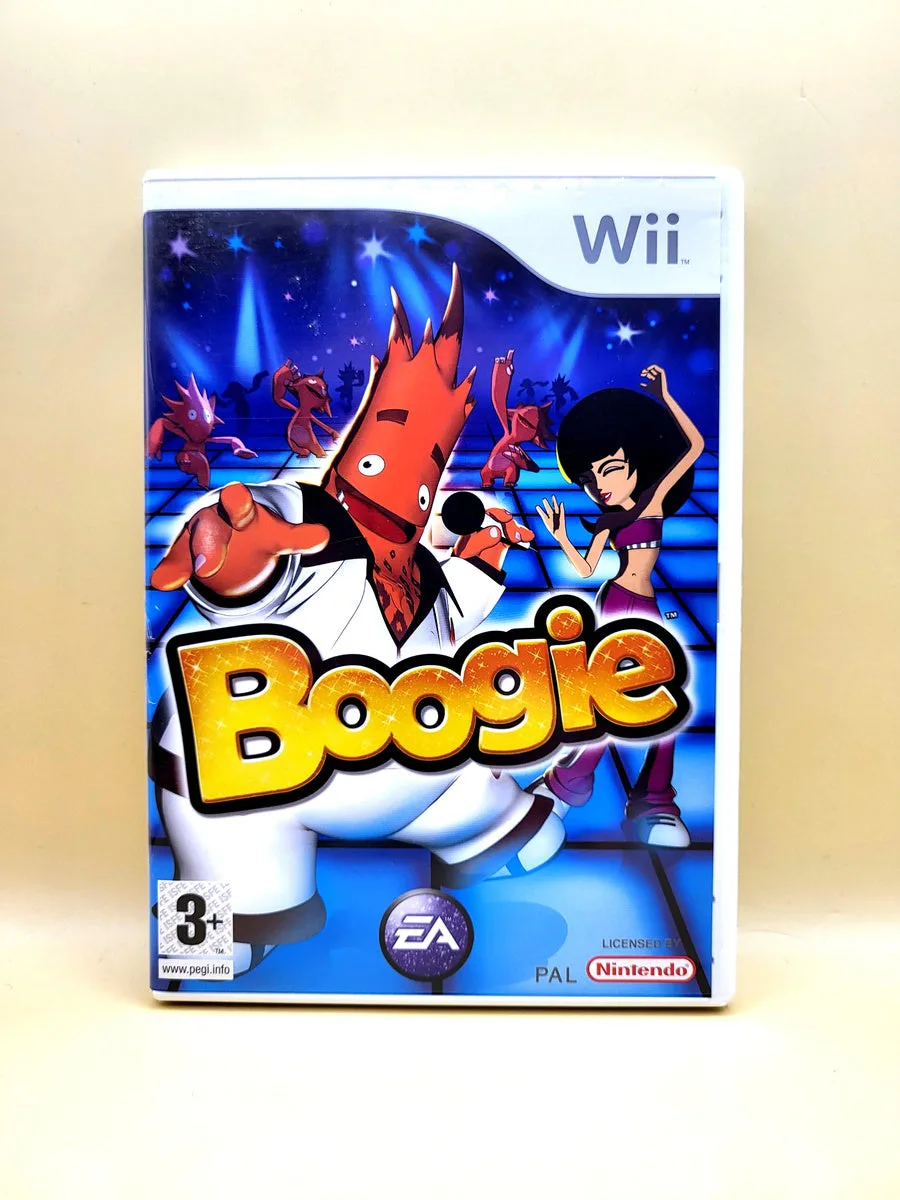
Boogie for Nintendo Wii
Boogie for Nintendo Wii combines dancing, karaoke and music-video creation in one rhythm game. You choose one of the quirky Boog characters and customise clothing and appearance. During dance songs, you move the Wii Remote and Nunchuk to the beat to perform steps, poses and special moves. For karaoke, you connect a USB microphone and follow lyrics and pitch on screen.
The career consists of five short storylines in which you perform, climb the rankings and unlock new songs and items. The soundtrack uses new performances of familiar disco, funk, pop and rock songs from different decades. Dancing and singing are separate activities: one judges rhythm and movement, the other your voice. Each session can therefore focus on active movement or a more traditional karaoke evening.
The music-video editor records a performance and lets you choose camera angles and effects for your own clip. Boogie also offers local cooperative activities, direct dance contests and karaoke for one or two players. All songs, stories and editing features are on the disc; no online connection is required. A pre-owned copy is sold as the game, without a guarantee that the originally bundled microphone is present.
Region and language
Our Nintendo Wii games are PAL editions and come with a Dutch or English box, unless stated otherwise. By default, you receive the version for the European market. We note it in the product details if the region is different or the box is in another language. In almost all cases, the game is playable at least in English, and often in the other five common European languages too.
Boogie supports one or two local players. Dancing requires a Wii Remote and Nunchuk for each active player; karaoke requires a compatible USB microphone. The product page describes only the game and does not promise an included microphone unless this is explicitly stated.
Manual
Boogie for Nintendo Wii includes the manual unless the product title states otherwise. If the booklet is missing, the title says “No Manual”. This lets you see before ordering whether the game comes with a manual.
The manuals included with our games usually contain at least English and often around six European languages. The exact languages vary by edition, so Dutch is not always included. The booklet explains the controls and the main rules. You can use it to check how to control the game, which actions are available and how its different features work.
The history of Boogie
EA Montreal developed Boogie as a new music-game series, and Electronic Arts released the Wii version in Europe on 31 August 2007. The project was designed around Nintendo's motion controls: not merely pressing buttons, but making a character dance with the Remote and Nunchuk. Pairing this with a USB microphone also gave the same disc a separate karaoke component.
Electronic Arts presented Boogie as a party game with dance battles, cooperative play, minigames and a music-video editor. The original retail bundle was offered with a karaoke microphone, but the software is separate from it. A used standalone game therefore should not be assumed to still include the accessory. The dance activities remain playable without a microphone; singing does require a compatible USB microphone.
Versions for PlayStation 2 and Nintendo DS appeared later in 2007, but they use different controls and content. The Wii edition remained recognisable through its combination of movement, singing and video editing. Boogie SuperStar followed in 2008, linking dance input more closely to prompts and introducing a different soundtrack and star career. This first Boogie disc retains its five storylines and original Boog characters.
Similar games for Nintendo Wii
Boogie SuperStar builds on singing and dancing but uses clear two-part movement patterns, more than forty pop covers and contests for up to four players. The first Boogie is freer, supports two players and distinguishes itself with five storylines and a music-video editor. SuperStar therefore has a more direct competitive structure.
Just Dance has players copy complete choreographies while only the Wii Remote registers movement. Boogie also uses a Nunchuk for dancing and lets a chosen character perform. Boogie additionally includes karaoke and video editing, whereas Just Dance is built entirely around dance routines.
Disney Sing It: Pop Hits focuses on singing with music videos, duets and songs by familiar teen-pop artists. Boogie combines karaoke with separate dance battles and fantasy characters. Both require a USB microphone for vocals, but only Boogie uses Wii movements for a second type of play.
Rayman Raving Rabbids contains dozens of short challenges with varied movements, shooting and quick reactions. Boogie stays with music and judges rhythm across complete songs. Both work well as local entertainment, but Boogie adds singing and an editor instead of constantly switching to a new minigame concept.
Guitar Hero World Tour forms a full band with guitar, bass, drums and vocals and uses separate instrument controllers. Boogie requires only a Wii Remote with Nunchuk for dancing and a USB microphone for singing. World Tour follows precise note highways; Boogie gives more room to movement and assembling a visual music video.