This product is like new. At NexWave Games, like new means:
Additionally, all discs at NexWave Games are carefully inspected and assessed for quality. When discs arrive, we do not accept any that are so badly damaged that they are unlikely to work. We only accept discs with light scratches at most. Discs with scratches are then treated in our professional disc repair machine. By warming the disc and polishing it with soft brushes, these machines can remove a very thin layer from the disc. This removes the layer containing surface scratches and improves the disc’s readability. This ensures the disc works properly, even on consoles with ageing lasers that have difficulty reading games! Great news for the player.
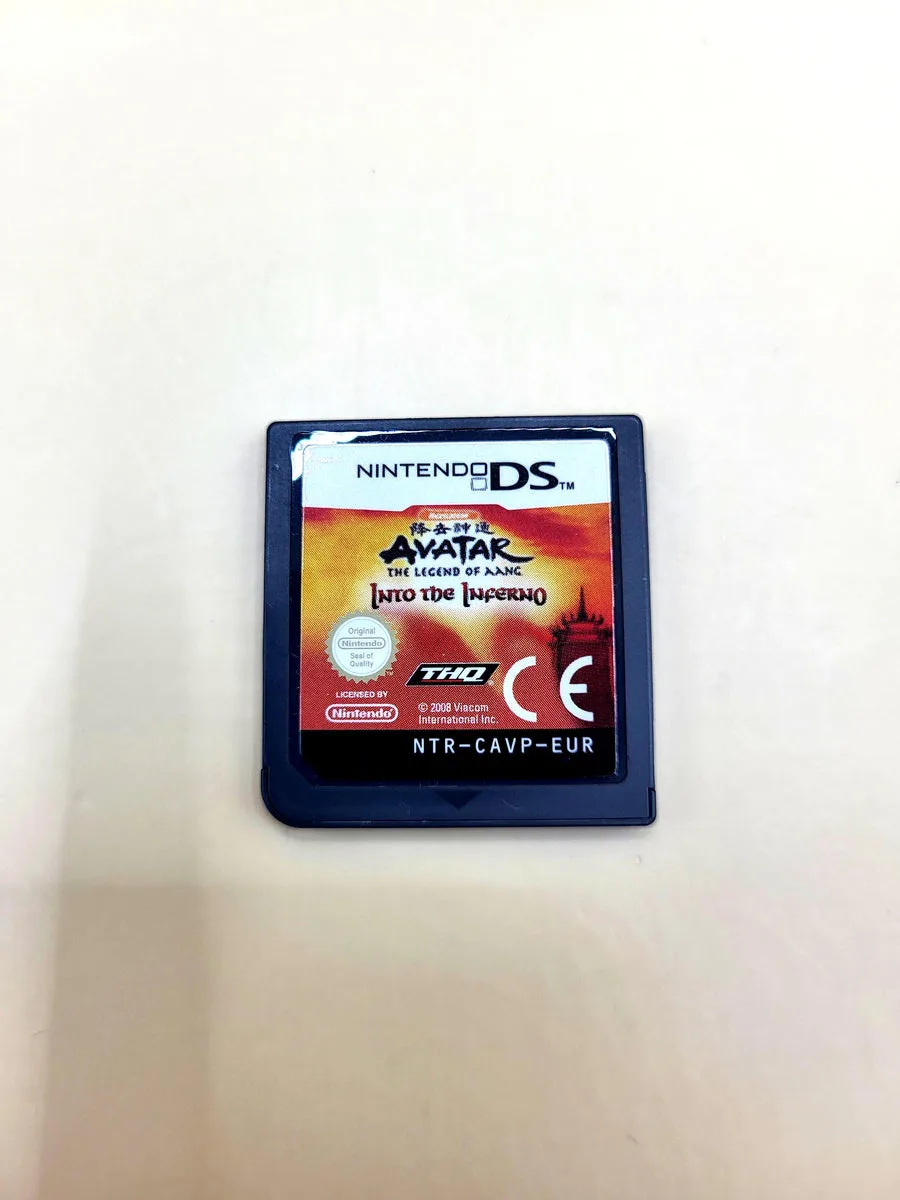
Avatar: The Legend of Aang - Into the Inferno for Nintendo DS
Avatar: The Legend of Aang - Into the Inferno for Nintendo DS follows Aang and his friends during their struggle against the Fire Nation. This action adventure uses an overhead view and small figures with strikingly large heads. Each level assigns you two characters. You guide them past enemies, switches and broken paths, while their different talents determine how you move forward. The events follow the cartoon's third season and the confrontation with Fire Lord Ozai.
You use the stylus to move the heroes and make them attack. Draw Sokka's boomerang route, build an ice bridge with Katara or move rocks with Toph. Sometimes you leave one character beside a switch while the other explores a passage. Look for water, rocks and other useful parts of the surroundings as well. An obstacle may require several actions before both friends safely reach the other side.
Alongside the adventure, there is beach volleyball for two players over a local wireless connection. With DS Download Play, one cartridge is enough, although both players need their own compatible DS system. There is also Multi-Card Play for two copies. The additional systems and any second cartridge are not included. In this minigame, you use the stylus to receive the ball and send it towards a spot on your opponent's court.
Region and language
Our Nintendo DS games are European editions, unless stated otherwise. This product contains a loose cartridge for the European market. A box is only included if explicitly stated in the product details. We note any different region in the product details. In almost all cases, the game is playable at least in English, and often in the other five common European languages too.
Manual
With Avatar: The Legend of Aang - Into the Inferno for Nintendo DS, you receive a loose cartridge. A box and manual are not included unless we explicitly state otherwise in the product details. This is the standard way we supply this copy.
The history of Avatar: The Legend of Aang - Into the Inferno
THQ released Into the Inferno in 2008 as a game based on Avatar's final season. The English-language series is called The Last Airbender in America; The Legend of Aang was also used in Europe. Its story about four elements and the war against the Fire Nation led to several game adaptations. This instalment focuses on the final stage of Aang's journey, as the threat from Ozai grows and the group has to act together.
Halfbrick developed the Nintendo DS version. It is a separate adaptation alongside the Wii and PlayStation 2 releases. The DS received its own large-headed character style and controls that rely heavily on the touch screen. That choice makes bending directly visible: you draw a route or move material around the playing area. Assigning a fixed pair to each level allowed the designers to build puzzles around precisely those two available abilities.
That emphasis on cooperation is therefore present in solo play too. One hero opens a path for the other, after which you coordinate their positions again. Fights interrupt that problem-solving, but combining powers remains the connecting activity. The separate beach volleyball game uses the same direct stylus controls for a short match. This gives the DS release a distinctive place within the series: small playing areas, tangible environmental puzzles and a duo whose positions you keep rearranging.
Similar games for Nintendo DS
The Legend of Zelda: Phantom Hourglass on Nintendo DS likewise lets you move, attack and draw a boomerang route with the stylus. That makes it a clear relative for anyone who enjoys acting directly in the playing area. Link also travels between islands by ship and explores dungeons using his own equipment. Into the Inferno builds its puzzles around two assigned Avatar characters and their elemental powers, so switching between partners is much more often the solution.
LOSTMAGIC for Nintendo DS links magic to symbols you draw on the touch screen. As with Aang's friends, you physically perform a movement to use a power. However, the game places greater emphasis on commanding monsters and tactically structured battles. Into the Inferno more often centres on a puzzle in the immediate surroundings: moving a stone, building a bridge and getting both heroes past the same obstacle.
LEGO Star Wars: The Complete Saga on Nintendo DS divides familiar film events into action levels where characters have different abilities. Its recognisable cast, short fights and light humour connect it with Into the Inferno. LEGO adds collecting studs, building with bricks and a large selection of characters to unlock. Avatar places greater emphasis on carefully using the fixed duo selected for a level.
Drawn to Life on Nintendo DS uses the stylus to draw your own hero and various objects. The touch screen therefore plays a creative role before you set off through side-scrolling platform levels. Into the Inferno has you control existing heroes and shape their powers while playing. Both combine drawing movements with a story, but in Avatar your movement mainly determines how you solve an obstacle, rather than how a character looks.
Kirby: Mouse Attack for Nintendo DS lets different powers affect the environment, for example by burning something or freezing water. That experimentation fits the elemental puzzles in Into the Inferno. Kirby explores side-scrolling levels, floats over hazards and copies enemies' abilities. Avatar uses an overhead view and two fixed partners per level, so your progress mainly depends on their mutual assistance and the materials already present.